


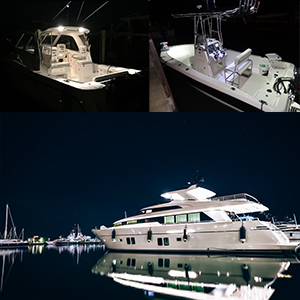
The nautical route and navigation occupy most of a sailor’s life. In that condition, marine navigation lights LED can be a saviour by providing maritime safety and efficiency. LED marine navigation lights are incorporated with vessel management systems, offering remote monitoring and real-time adjustments. These systems use automated controls to maximize visibility and minimize energy consumption. LED lights that, depending on the time of day, automatically change their colour and intensity. Weather conditions and other environmental tasks are being done on the deck. Lights are also important, even for fishing, because some lights attract specific fish species, improving fish catching.
This level of sophistication focuses on lighting control, which not only improves safety but also streamlines ship operations. By controlling all lighting systems from a single interface, crew members can lower the possibility of human mistakes and guarantee that lights are always set up for maximum efficiency.
1. LED Marine Navigation Lights Improve Safety
Emergency response systems and collision avoidance technology are examples of advanced navigation lights for ships. Real-time diagnostics ensure dependable performance during crucial operations by alerting staff to faults. Basic fault detection is not the only function of modern systems.
To foresee such breakdowns before they happen, they use predictive maintenance algorithms that examine performance data. For example, the system can notify the crew well in advance if a light’s function starts to deteriorate, enabling preventive maintenance during regular downtime rather than during a crucial operation.
2. LED Marine Navigation Lights’ Sustainability and Energy Efficiency
Because LED lights use a lot less power than traditional lights, naval boats have a lower carbon footprint. This makes marine navigation lights more environmentally sustainable and is in line with global sustainability goals.
There are significant energy savings. Over time, a typical LED system can reduce energy use by up to 90%, resulting in significant fuel savings and decreased operating expenses. This decrease in energy use might result in considerable cost savings for a commercial fishing vessel that spends a lot of time at sea.
Additionally, a vessel’s electrical systems are less taxed by the decreased power demand, which may prolong the life of batteries and other electrical components.
3. LED Marine Navigation Lights: Durable and Weather Resistant
LED marine navigation lights are made with sturdy construction and corrosion-resistant components to withstand challenging maritime environments. This ensures long-term performance in harsh weather conditions and saltwater settings. Because saltwater is so corrosive, traditional lighting systems often break down fast in such environments. To prevent corrosion, modern LED lights are made of materials like anodised aluminium and marine-grade stainless steel. Since their housings are sealed to prevent water intrusion, internal parts stay dry and functional even after extended exposure to spray and submersion.
4. LED Marine Navigation Lights: Industry Acceptance and Innovation
LED lighting is being quickly adopted by the marine industry, spurring additional innovation. The future of marine navigation lights offers even more improvements in efficiency and safety, from energy harvesting to AI integration. The industry gains from improved technology and shared expertise as more ships convert to LED systems. Based on consumer feedback and new technical developments, manufacturers are constantly improving their products.
5. LED Marine Navigation Light Maintenance and Cost-effectiveness
When it comes to cost and maintenance, LED maritime navigation lights have a lot to offer. Their lifespan, which often surpasses 50,000 hours, significantly lowers the need for bulb replacements. This reduces the amount of manpower needed for maintenance as well as the cost of new parts. These lights’ sturdy design also helps to reduce unplanned malfunctions, guaranteeing that ships can function without unexpectedly losing vital lighting.
